
Ten years of litigation to prove that one plus one equals two. Seven complaints shelved, more than forty proceedings lost and an institutional wall that will not give way. Our judicial journey is no personal anecdote: it portrays a system in which judges, prosecutors and public bodies seem to close ranks whenever someone reports one of their own.
When 1 + 1 no longer makes 2
It is hard to understand how, after ten years of cumbersome court proceedings, facts as basic as "1 + 1 = 2" have still not been recognised. Throughout this time we have defended arithmetical truths against those who claim, with institutional backing, that "1 + 1 = 3". Behind that impossible arithmetic we allege an act of misappropriation that, to date, no authority has been willing to acknowledge.
In our view, this journey has involved numerous breaches of the rule of law. We face what we perceive as a network of interests involving many institutions, including the most sensitive of all: the judiciary. Telling the lawful from the merely corporate ought to be simple for those who are guardians of the law. Our experience suggests otherwise.
A decade in figures
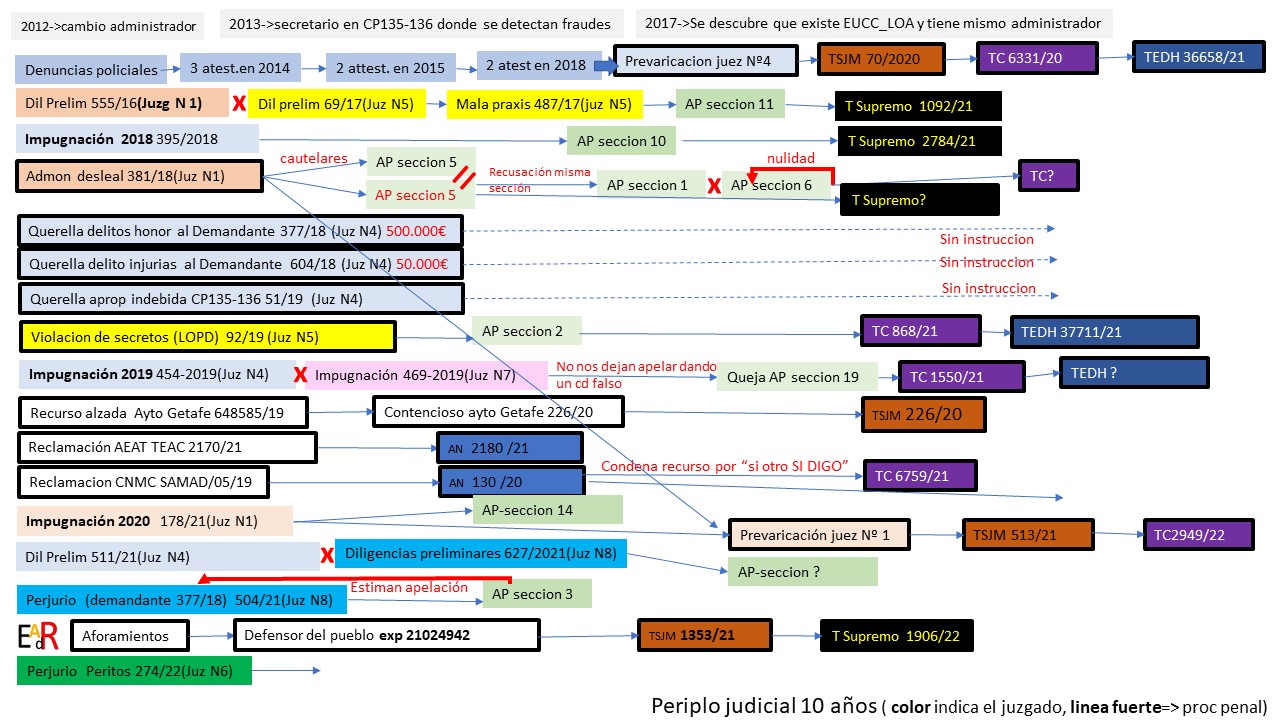
The chart sums up our story. These are the most significant milestones:
- Seven police complaints, all shelved without any investigation by the courts that handled them.
- More than forty court proceedings (criminal complaints, claims, appeals, challenges to judges), every one ending in inadmissibility, dismissal or an order to pay costs against the complainant.
- Two proceedings brought against the complainant, claiming €500,000 and €50,000, which we regard as attempts at intimidation and which had gone four years without any investigative step. In one of them we reported a flagrant breach of data protection law that the supervisory authority did not recognise.
- Repeated allocation of cases to the same chambers or jurisdictions, reported to the General Council of the Judiciary without that governing body appearing to consider it relevant.
The prosecution service, absent
The Public Prosecutor's Office, constitutionally bound to uphold legality, has found no offence in its reports. The specialised Anti-Corruption Prosecutor's Office likewise detected no wrongdoing in the more than four reports it issued in 2021, and the Prosecution Inspectorate found no misconduct by its prosecutors. When every safeguard agrees on seeing nothing, citizens are entitled to ask whether the problem lies in what was reported or in those who should investigate it.
Not one correct ruling among forty judges
In the two criminal complaints for judicial malfeasance we filed, the judges' defence rested on the argument that citizens have no "right to a correct decision". It is a familiar argument. But when, across more than forty rulings, not one sides with the party providing documentary evidence, the statistics cease to be coincidence and become an indication.
Further episodes, in our view, call for an explanation:
- In one of the appeals, we allege that the submission of a defective digital storage disc delayed the proceedings until the statutory deadline to appeal had expired.
- It has still not been accepted that a non-profit entity neither should nor can generate profit and that, if it did, it would not be liable to corporation tax.
- Nor has the European Court of Human Rights so far examined the substance of the coercion and the violations of fundamental rights we have documented.
When defending the obvious takes ten years and forty cases, what is at stake is no longer a lawsuit but the credibility of the rule of law itself.
Why we tell this story
We tell our story because it is not unique. Thousands of citizens and small businesses face, every day, structures that protect themselves across all three branches of power: tailor-made rules, authorities that do not respond and courts that do not listen. European rule of law reports and GRECO evaluations have for years been urging Spain to strengthen guarantees of judicial independence and accountability.
We are not asking for privileges, only for justice: that facts be investigated, that those who sign be answerable, and that citizens who report wrongdoing be protected rather than punished. If you would like more details of our case or have experienced something similar, contact us through our contact form. Together, we are harder to silence.