
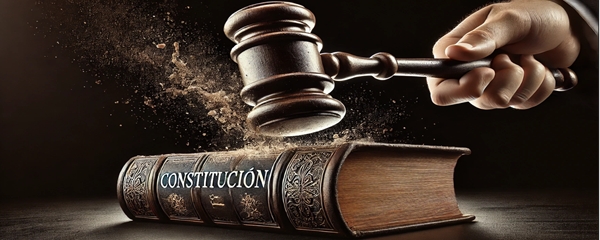
Kleptocracy: government by thieves. In two thousand years of history, hardly any empire has escaped it. Constitutional democracies were born precisely to prevent it, with free elections and checks that give meaning to the rule of law. The question is uncomfortable but necessary: how many features of a kleptocracy would an impartial observer recognise in Spain today?
An evil as old as power
If we had to name one evil common to every country or organisation on the planet, it would be kleptocracy: the use of public power for the private enrichment of those who wield it. No empire of the last two millennia has been immune to it.
After the Second World War, most countries adopted democracy as a guarantee that sovereignty lies with the people and that rulers are chosen by them. To that formula was added a code for living together, the Constitution, with mechanisms for each branch to check the others. When those mechanisms work, we speak of the rule of law. When they rust, the door is left open. Shall we look in the mirror?
Seven features of a kleptocracy
Scholars of the phenomenon agree on a set of symptoms. Let us review them one by one, comparing them with what we observe and denounce in our country:
- Widespread corruption, present at every level of government. For years Spain has accumulated corruption scandals with a political background; very occasionally someone goes to prison but, paradoxically, the missing money almost never turns up.
- Diversion of public funds into the accounts of leaders and their associates. Investigative journalism and international leaks have pointed to assets in tax havens linked to political figures and their circles, without an institutional response equal to the challenge.
- Illicit enrichment under cover of office. Whenever anyone tries to hold a branch of the state to account, special jurisdiction for office-holders appears as a shield. What exactly is being protected?
- Lack of accountability: no effective oversight or auditing mechanisms. In our experience, complaints calling for scrutiny of how public money is spent end up shelved without investigation.
- Weakened oversight institutions: the judiciary, regulators and the press co-opted or neutralised. We have endured more than forty years of aforamientos that remove the powerful from the ordinary courts.
- Manipulation of public debate: controlling the media is a way of conditioning elections. We have seen the spaces where citizens' protests surface being singled out and discredited.
- Repression of dissent through intimidation, censorship or imprisonment. A judge who reported alleged corruption in the courts has been deprived of his liberty, and our own members have suffered economic pressure unworthy of an advanced democracy.
The missing piece: the money
If anything distinguishes a kleptocracy from a democracy with isolated cases of corruption, it is the fate of the loot. In healthy democracies, conviction goes hand in hand with recovery of what was taken. In Spain, by contrast, the public perception is that sentences are few and late, and that stolen assets rarely return to the public purse.
Tools are not lacking. The United Nations Convention against Corruption devotes an entire chapter to asset recovery; the StAR Initiative, run by the World Bank and UNODC, works to end safe havens for corrupt funds; and the European Public Prosecutor's Office, in which Spain participates, prosecutes crimes against the EU budget. What is missing is not instruments but the political and judicial will to use them to the full.
A democracy is not measured by the corrupt it puts on trial, but by the stolen money it gives back to its citizens.
Breaking the cycle
Kleptocracy belongs to no single party or branch: it thrives when the legislature legislates privileges, the executive colonises oversight bodies and part of the judiciary looks the other way. Reversing it means acting on all three fronts at once:
- Abolition of aforamientos and full equality before the law.
- Prosecution services and oversight bodies with genuine independence and adequate resources.
- Systematic pursuit of assets: confiscation, recovery and international cooperation.
- Effective protection for whistleblowers and journalists who expose wrongdoing.
Kleptocrats rely on a silent ally: resignation. Every citizen who gets informed, reports wrongdoing and demands accountability takes a little of that ground away from them. We invite you to take that step with us.