

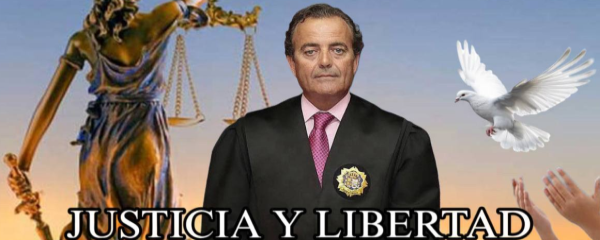
I am astonished to read, on the front page of the country's best-selling newspaper, that in China a person has been jailed for 400 days for their ideas. And I wonder when I will read in those same pages that the Kingdom of Spain has kept a judge who reported judicial corruption behind bars for 1,193 days.
Double standards
On 17 October 2025, the front page devoted its main space to the injustice of imprisoning someone for 400 days for their opinions under an authoritarian regime. It is a necessary denunciation and I endorse it without reservation. But selective outrage has something of an alibi about it: it is convenient to point at distant abuses while keeping silent about those taking place a few kilometres from the newsroom.
Because in Spain there is a judge who has, as of 12 October 2026, been deprived of his liberty for 1,193 days. His offence, according to him and his supporters, was to report alleged undeclared accounts held by senior judges in tax havens. We will be told that the accusation is false. Perhaps. But who has investigated it? How could our judges possibly have hidden money, if they belong, as we are asked to believe, to a caste of human beings purer than the rest? The same was said for decades of other powers that history has gradually revealed to be as human and as fallible as anyone else.
The facts complained of
The background, as set out in the complaint lodged in this case for alleged violation of fundamental rights, can be summarised as follows:
- The judge was deprived of his liberty under a court decision of 17 July 2023.
- Four days later, by an order of 21 July 2023, the National High Court (Audiencia Nacional) ordered his release.
- Despite this, he has spent more than three years in prison without, according to the complaint, any duly reasoned and notified detention order.
- Between 2001 and 2022 he had filed reports with the Spanish Tax Agency against various judges concerning alleged undeclared accounts in tax havens.
Rights that admit no exceptions
If these facts are confirmed, we would be facing an alleged breach of two basic guarantees of the European legal order. Article 5 of the European Convention on Human Rights protects the right to liberty and security, and permits deprivation of liberty only in the cases and in accordance with the procedure prescribed by law. Article 47 of the Charter of Fundamental Rights of the European Union guarantees the right to an effective remedy and to a fair trial before an impartial tribunal. Neither distinguishes between awkward citizens and docile ones.
In the view of those who have raised the complaint, the circumstances of the case point to a form of reprisal for having exposed alleged corruption at the very top of the judiciary. And that is the heart of the problem: when the whistleblower ends up in prison and what was reported goes uninvestigated, the message society receives is devastating.
A state that jails the whistleblower and fails to investigate the complaint is not protecting justice: it is protecting those who fear justice.
The silence of the institutions
The legal system is not short of tools. The complainants invoke the new Article 988 bis of the Spanish Criminal Procedure Act as a route for reviewing irregular judicial decisions. Yet no court, neither the Public Prosecutor's Office nor the General Council of the Judiciary, has acted of its own motion to clarify what happened. Nor is there any record of anyone having seriously checked whether those reports to the Tax Agency had any basis.
The silence, moreover, cuts across the board. We are not aware of the legislature having asked for explanations or of the Government having lifted a finger, and the judiciary itself appears to have chosen to look the other way. Much of the press, so attentive to arbitrary conduct in other countries, has preferred not to rock the boat.
What we are asking for
- An urgent review, with full safeguards, of the deprivation of liberty complained of.
- An independent investigation of the reports concerning alleged undeclared accounts held by senior judicial officials.
- Genuine application of the protection that Law 2/2023 grants to those who report breaches of the law and corruption.
- That the media hold our own courts to the same standard they apply to foreign regimes.
Dear Editor, I am not asking you to accept any accusation as true. I am asking for something simpler and more journalistic: that you ask questions. That your newspaper take an interest in a judge imprisoned in Spain with the same energy it devotes to denouncing distant abuses. The health of a democracy is measured by how it treats those who expose the powerful, and the credibility of a newspaper by its courage in reporting it.