
Spain presents itself to the world as a consolidated state governed by the rule of law, yet international indices and many citizens' daily experience tell another story: whistleblowers who end up targeted, lawsuits that drag on for years, procedural privileges that shield a few and defrauded millions that never come back. Measuring the rule of law is no academic exercise.
An exam we do not pass with honours
Saying that Spain lacks a genuine rule of law is uncomfortable, but the data invite us to say it plainly. In 2022, the international ranking reproduced on Wikipedia placed our country 23rd, behind democracies we like to compare ourselves with. And that was before situations came to light that ought to shame any system: citizens imprisoned or intimidated after reporting corruption, even though Law 2/2023, on the protection of persons who report regulatory breaches and on the fight against corruption, was passed precisely to protect them.
Meanwhile, billions lost to fraud simply evaporate, while neither the Public Prosecution Service nor the courts —formally independent of each other, yet staffed by people who sat the same competitive examination and share the same professional origins— show any resolute will to recover them. The usual consolation is to look down the table: there are worse countries. But settling for not being last is the most comfortable way of never improving.
The four pillars of the rule of law
The World Justice Project, an independent organisation that publishes one of the leading annual indices on the subject, starts from four universal principles that any country claiming to uphold the rule of law must meet:
- Accountability: government and private actors alike answer to the law for their actions.
- Just laws: clear, publicised, stable, evenly applied and protective of fundamental rights.
- Open government: the processes by which laws are made, administered and enforced are accessible, fair and efficient.
- Accessible and impartial justice: swift, affordable means of resolving disputes, delivered by competent and independent judges.
Spain in the mirror
Let us apply those pillars to our reality with a few awkward questions:
- Accountability? Complaints have been filed about alleged funds in tax havens linked to representatives of all three branches —government, parliament and the judiciary— and no investigation has got to the bottom of them. Are we really that spotless?
- Just laws? Article 14 of the Constitution proclaims equality before the law, yet for almost four decades we have lived with a system of aforamientos —special criminal jurisdiction for office-holders— which, by the estimates in circulation, covers some 240,000 people.
- Swift proceedings? A lawsuit lasting ten years is no rarity, and recovering the costs awarded in a judgment can become another odyssey.
- Accessible remedies? If an electricity supplier deceives you, arbitration can take nine months; add the time it takes to spot the problem on your first bill and a consumer may wait a whole year for an answer.
How the rule of law is measured
The World Justice Project index is not based on impressions but on household and expert surveys across well over a hundred countries, grouped into eight factors:
- Constraints on government powers.
- Absence of corruption.
- Open government.
- Fundamental rights.
- Order and security.
- Regulatory enforcement.
- Civil justice.
- Criminal justice.
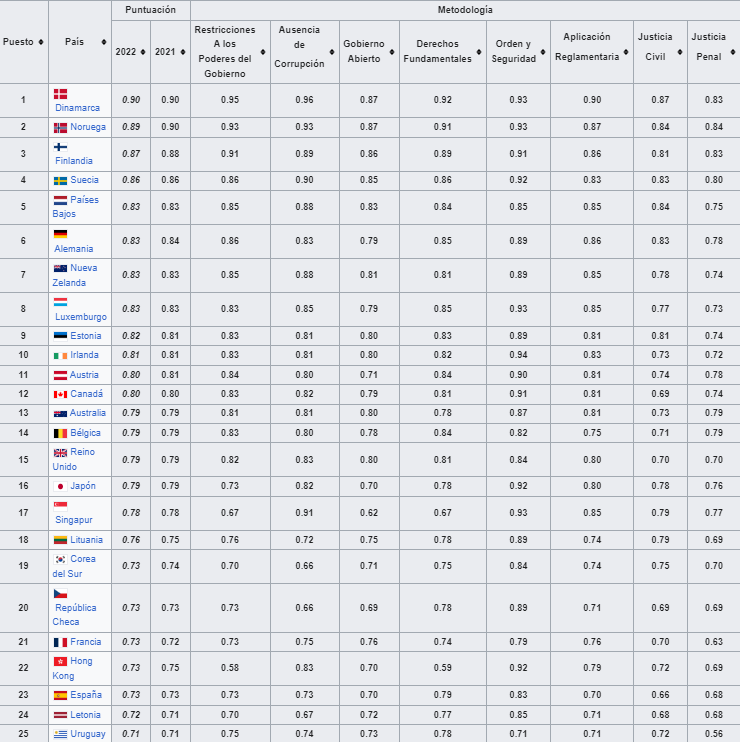
Spain's results deserve a careful reading. We score well on order and security —the work of our police forces is recognised— but criminal justice carries one of the lowest marks of the whole set. In other words, the state knows how to keep order on the streets but fails when it comes to judging swiftly, impartially and effectively, above all when the person who must answer for their conduct holds a position of power.
The rule of law is not measured by what a constitution proclaims, but by what happens to those who dare to speak up.
Neither complacency nor resignation
The decline is not the fault of a single branch. The legislature maintains procedural privileges that the European Commission has been flagging in its reports for years; the government fails to push the reforms that would guarantee the independence of oversight bodies; and part of the judiciary and the prosecution service seems more inclined to protect the system than to clean it up. Each of them could break the cycle; none has done so.
That is why the answer must come from citizens. We demand:
- The abolition of aforamientos and full equality before the law.
- Genuine enforcement of Law 2/2023, with effective protection for anyone who reports corruption, including within the courts.
- Reasonable court deadlines and sufficient resources to meet them.
- Effective recovery of defrauded money.
Knowing the indices, sharing them and demanding explanations is the first step. A country does not climb the rankings by accident: it does so when its citizens stop settling for less.